



There is a moment that catches almost every first-time visitor off guard at Har Ki Pauri.
You have seen the photographs. Maybe watched a documentary. You think you know what to expect. Then you walk down those worn stone steps at 4 AM the air sharp with cold, the chanting already rising off the walls, the Ganga glinting gold from a thousand oil lamps and something you cannot quite name shifts inside you.
That is Ardh Kumbh Mela 2027 in Haridwar, No article, however thorough, entirely prepares you for it.
What this guide will do is get you as close to prepared as possible, bathing dates, crowd realities, transport costs, accommodation truths, and the practical details that most Kumbh guides quietly skip. It is written by operators who have coordinated pilgrim transport to Haridwar across multiple Kumbh cycles, and whose drivers have navigated the ghat corridors since before the smartphone era.
Travelling from Delhi in a group? We cover transport options and pricing in detail below. But the experience comes first.
Quick Facts: Ardh Kumbh Mela 2027 at a Glance
Short Answer: Ardh Kumbh Mela 2027 takes place in Haridwar, Uttarakhand, along the Ganga river. Key bathing occasions include Makar Sankranti, Mauni Amavasya, Basant Panchami, Maghi Purnima, and Maha Shivratri. Exact dates are confirmed by the Uttarakhand government based on the Hindu calendar verify at the official Uttarakhand Tourism website before booking travel.
| Detail | Information |
|---|---|
| Event Name | Ardh Kumbh Mela 2027 |
| Location | Haridwar, Uttarakhand, India |
| Main Ghat | Har Ki Pauri |
| Sacred River | Ganga (Ganges) |
| Expected Footfall | Tens of millions of pilgrims across the Mela period |
| Best Time to Visit | Pre-dawn Snan dates; caution advised on Mauni Amavasya |
| Distance from Delhi | ~250 km via NH 334 |
| Ideal Trip Duration | 3 to 5 days |
| Key Ritual | Shahi Snan (Royal Bath) |
| Recommended Transport | Delhi to Haridwar Tempo Traveller for groups of 9–26 |
What Is Ardh Kumbh Mela and Why 2027 Is Worth Attending
Definition: Ardh means half. Kumbh refers to the pot of Amrit (immortality nectar) from Hindu mythology. Mela means fair. Together: the Half Kumbh, a major pilgrimage held every six years at Haridwar, sitting between the full Kumbh Melas that occur every twelve.
The mythology is vivid. When gods and demons churned the cosmic ocean to extract Amrit, drops of the nectar fell at four sacred places: Haridwar, Prayagraj, Nashik, and Ujjain. These cities have hosted rotating Kumbh celebrations for thousands of years. Haridwar’s turn comes in 2027.
Haridwar Kumbh Mela 2027 follows the Mahakumbh in Prayagraj in early 2025, which drew an extraordinary number of pilgrims from across the country. Spiritual momentum has carried strongly since then. Families who could not attend Prayagraj are planning to go to Haridwar. Those who did attend are already asking about the next Mela because once you have stood at the edge of a Kumbh, you understand why people return.
Check Guide to : Delhi to Haridwar Road Trip

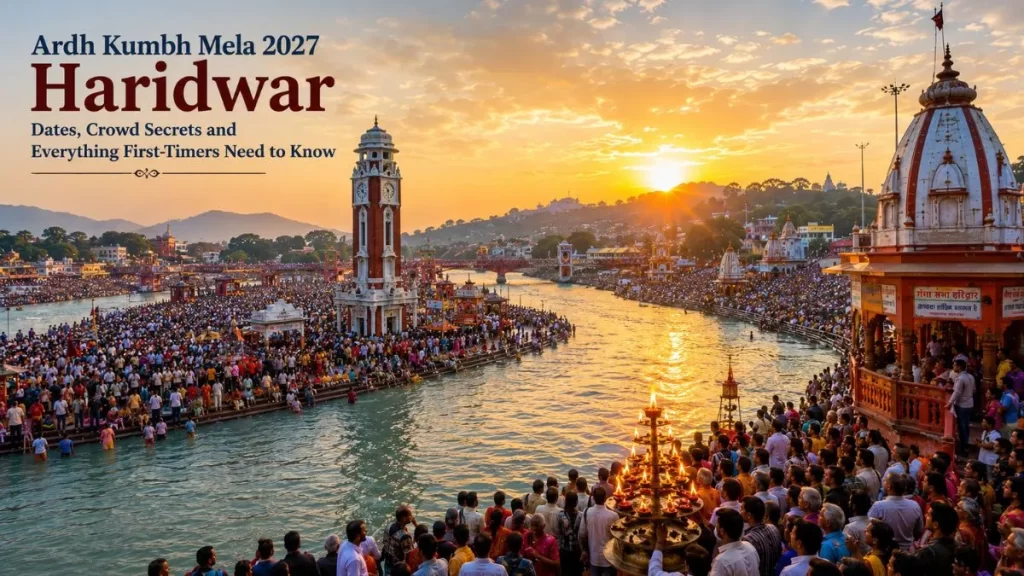
Why Haridwar Stands Apart from Other Holy Cities
India is full of sacred cities. But Haridwar has a quality that is hard to name.
It might be the geography that the Ganga descends from the Shivalik Hills and slows down here, spreading wide across the plains, turning a particular grey-green that looks ancient. It might be the sound of Haridwar that never fully goes quiet. Bells ring at odd hours. Pilgrims chant at the water’s edge before dawn. The river keeps a constant, low rumble that you stop noticing until you pause and listen again.
During Haridwar Kumbh 2027, the city transforms entirely. Temporary tent cities appear on the banks. Naga Sadhus, who spend years in mountain solitude, descend to the ghats. Pilgrims from every state, Rajasthan, Tamil Nadu, Bengal, and Maharashtra sit together at the water’s edge in a shared silence that cuts across language and background.
Key attractions during your visit:
- Har Ki Pauri: the most sacred bathing ghat; the Ganga is believed to carry its highest potency here
- Mansa Devi Temple: hilltop shrine accessible by cable car; views at dawn are extraordinary
- Chandi Devi Temple: reachable by ropeway or a forested 3 km trek
- Sapt Rishi Ashram: 5 km upstream, calm and rarely overcrowded; the Ganga splits into seven streams here
- Bharat Mata Mandir: a multi-storey temple dedicated to India herself, unlike anything else in the country
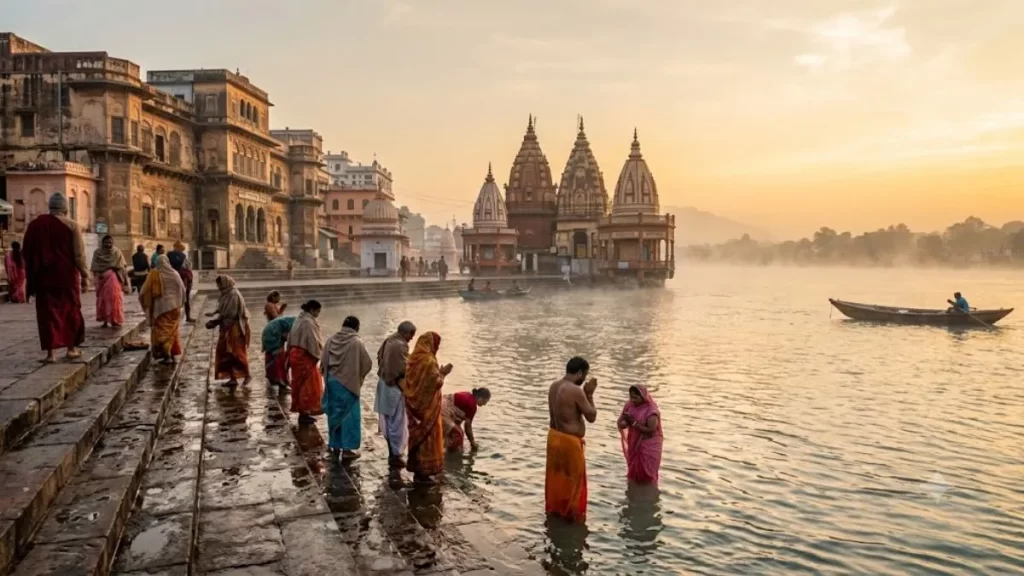
Ardh Kumbh Mela 2027 Key Bathing Dates (Shahi Snan Calendar)
Short Answer: The principal Shahi Snan dates for Kumbh Mela Haridwar 2027 fall on Makar Sankranti, Mauni Amavasya, Basant Panchami, Maghi Purnima, and Maha Shivratri. Official dates are confirmed by the Uttarakhand state government closer to the event; bookmark the Uttarakhand Tourism website and verify before booking.
The holy dip is the heart of the Kumbh. Everything else – the processions, the discourses, the marigold-sellers revolves around these specific dates when bathing in the Ganga is considered most auspicious.
| Bathing Occasion | Significance |
|---|---|
| Makar Sankranti | Opening of the bathing season; sun enters Capricorn |
| Mauni Amavasya | Most sacred day; no-moon day of silence; largest crowds |
| Basant Panchami | Spring’s arrival; bathing said to bring wisdom |
| Maghi Purnima | Full moon bath; especially powerful at dawn |
| Maha Shivratri | Lord Shiva’s night; Naga Sadhus most visible |
First-timer’s honest note: Mauni Amavasya at Kumbh Mela Haridwar 2027 will draw tens of millions of people on a single day. If you are bringing elderly relatives or young children, choose a quieter Snan morning the spiritual significance is equal, and the experience is far safer.
✦ Travel Expert Tip – Snan Dates
The single most common planning mistake we see is treating all Snan days as identical. They are not. Mauni Amavasya is a category apart: crowd pressure at the ghats can make it genuinely difficult to move freely. Our recommendation for first-time families: attend the Shahi Snan procession as a spectator from the access road on Mauni Amavasya, and take your own holy dip on Basant Panchami or Maghi Purnima morning. You will get the spiritual bath and witness the spectacle safely.
The Shahi Snan: What Actually Happens When the Akharas March

No description fully prepares you. But here is an honest account.
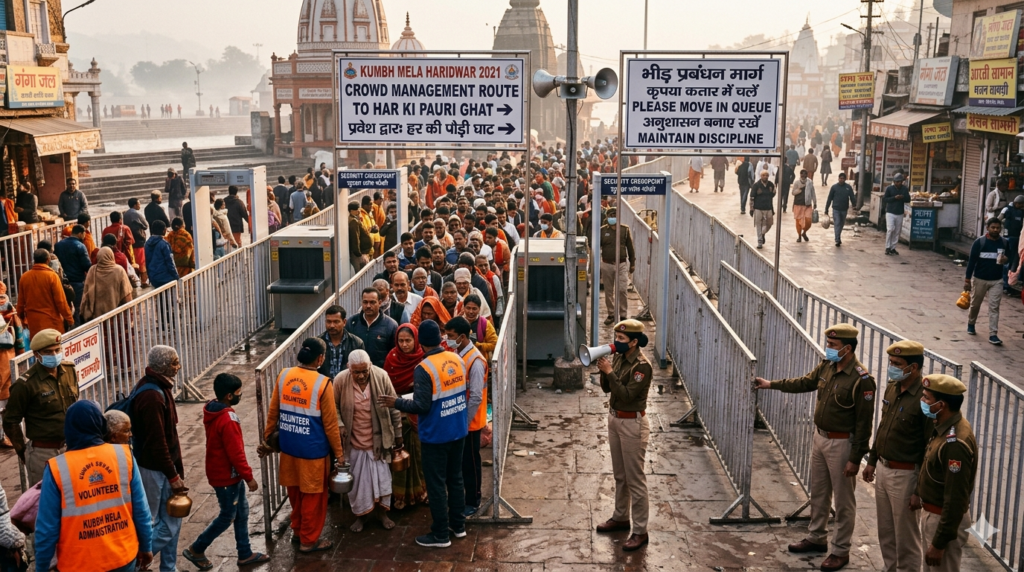
By 3 AM, the ghats are already filling. The air is cold. Police and Mela volunteers form human corridors to manage the crowd. Then the Akharas begin.
These ancient religious orders some tracing their lineage to Adi Shankaracharya in the 8th century march to the Ganga in a fixed ceremonial sequence. Naga Sadhus lead: ash-covered, having renounced all possessions, walking with a fierce calm. Vaishnava saints follow on decorated elephants. Warrior-ascetics carry flags and traditional weapons, not as threats but as symbols of spiritual discipline.
What strikes first-time visitors is the contrast. These are men who own nothing, yet they arrive with the gravity of emperors. There is no performance in it.
When the Akharas enter the water, the belief holds that the Ganga becomes charged with their accumulated spiritual energy. Pilgrims who bathe immediately after are said to receive the most potent blessing of the entire Mela.
Practical: Arrive at the ghats by 4 AM. Follow the crowd-flow markers. Hold the iron chains at the water’s edge. The immersion itself is brief. What it leaves behind is not.

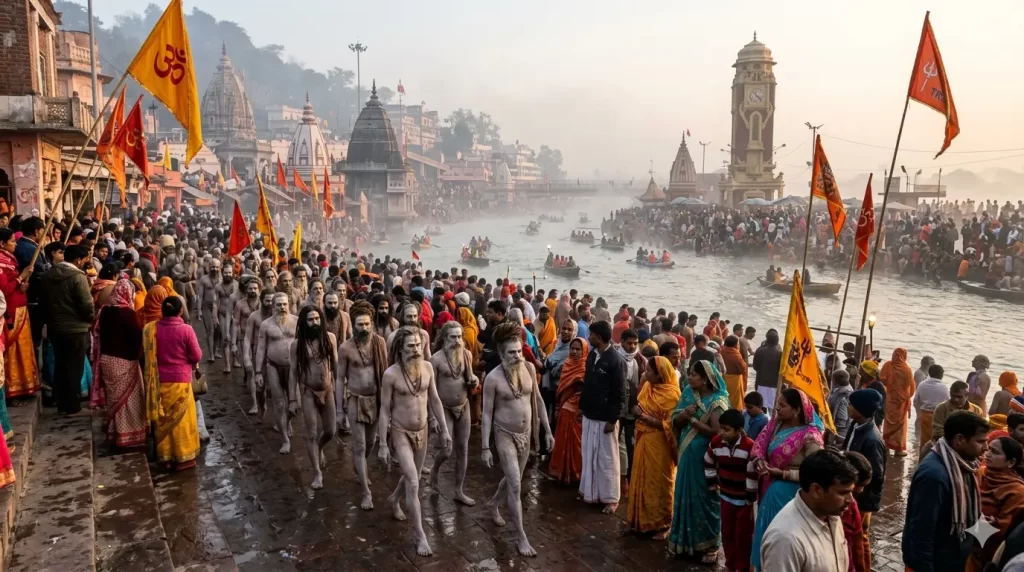
What to Expect at Har Ki Pauri: A First-Timer’s Honest Preview
The steps are steep and permanently wet. Wear rubber sandals you don’t mind soaking. The Ganga current is stronger than it appears, holding the iron chains bolted into the steps. They exist because the river deserves respect.
Priests will approach you. Pandas (hereditary ghat priests) offer puja services, ancestral rites, and tarpan ceremonies. Some are sincere and knowledgeable. Agree on a price clearly before beginning anything. A polite decline is entirely acceptable.
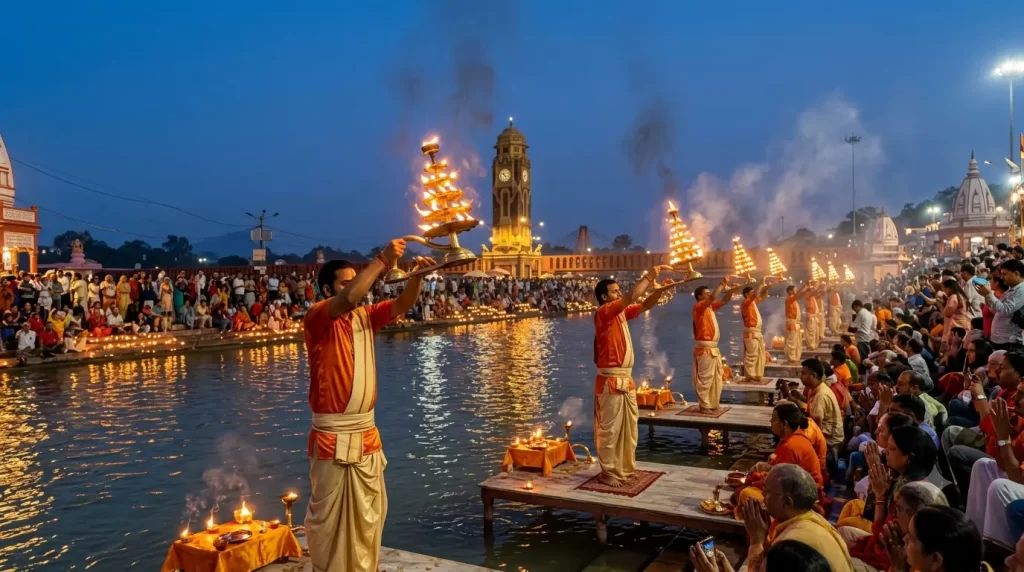
The Ganga Aarti is in the evening, not the morning. This surprises a significant number of first-timers. The famous Aarti at Har Ki Pauri happens around 6–7 PM (seasonally variable). It lasts 45 minutes. Arrive 30 minutes early for a railing spot. It is genuinely one of the most beautiful things you will witness anywhere in India.
Leave your shoes at the stand outside. Paid shoe-stands operate near the main entrance. Use them. Keep cash in a front pocket, not a wallet in a bag navigating the crowd with a large bag on your back is harder than it sounds.
Expert Observation: At Har Ki Pauri during Kumbh season, the ghat fills from the river outward not the steps inward. The deepest congestion is always at the water’s edge, not the approach lanes. If you feel crowd pressure building, move toward the outer walls and let the main flow pass. Police at the ghat are well-trained for this; follow their guidance immediately.
Best Time of Day to Take a Holy Dip at Haridwar
Short Answer: Best Times to Bathe at Har Ki Pauri Kumbh Mela:
- 4:30–6:30 AM: Brahma Muhurta (most auspicious, least crowded)
- 6:30–9:00 AM: Sunrise window (active, manageable)
- 2:00–5:00 PM: Underrated; peaceful on non-peak days, good for elderly pilgrims
- Avoid 9 AM-noon on major Snan dates: peak crowd density
4:30 to 6:30 AM is the single best window. The pre-dawn Brahma Muhurta is considered the most auspicious for bathing. Crowd density is lower, the light on the water is extraordinary, and the atmosphere is more contemplative than chaotic.
6:30 to 9 AM is active and manageable. Sunrise brings the second wave of pilgrims and a noisier, more energetic ghat. Good for those who need daylight.
9 AM to noon is the peak crowd window on major Snan dates. Avoid this slot if travelling with elderly family members or children.
2 to 5 PM is underrated. On non-peak days, a mid-afternoon dip is surprisingly peaceful most pilgrims are resting after their morning rituals. A genuine and safe alternative for elderly relatives who cannot manage pre-dawn starts.
Evening is for the Aarti, not the Snan. The ghat is at maximum capacity and does not clear until 8 PM.
Things Nobody Tells You About Visiting Ardh Kumbh Mela 2027
These are the things that consistently surprise first-time pilgrims drawn from multiple Kumbh cycles of coordinating pilgrim transport and logistics.
The silence inside the crowd. On Shahi Snan mornings, surrounded by millions, there are brief moments of extraordinary stillness when the first Akhara enters the water and the chanting pauses. That quiet is unlike anything.
Accommodation 1 km from Har Ki Pauri fills first. Most people book by hotel name without checking actual walking distance. A 3 km walk at 4 AM in January cold, twice daily, is punishing for elderly relatives. Proximity is worth paying more for.
The market lanes behind the ghat deserve an hour of your time. Brass idols, rudraksha malas, Ayurvedic products priced significantly below what you would pay elsewhere. Save unscheduled time on your final day.
Traffic inside Haridwar effectively stops on major Snan days. Vehicle-free zones extend several kilometres around the ghats. Plan to walk the last one to two kilometres regardless of how you arrive. Your driver cannot get closer experienced Kumbh drivers brief passengers on exactly this before departure.
Mobile networks struggle on peak days. Towers become overloaded by simultaneous users across tens of millions of phones. BSNL has held up better than private operators in our experience during past Melas. More importantly: fix a physical meeting point with your group before entering the ghat. Do not depend on WhatsApp to regroup.
The pre-dawn cold is more serious than people expect. Haridwar in January–February can drop to 5–6°C before sunrise. Add wind, a river immersion, and standing in a damp crowd pack a thick dry towel, a warm layer, and a complete change of clothes in a waterproof bag.
Expert Insight From a Repeat Kumbh Operator: One detail that never makes travel blogs: the chai stalls that appear at 3:30 AM on Snan days, about 400 metres from the main ghat approach, are often run by the same families who have served pilgrims here for generations. The tea is genuinely remarkable at that hour and the ten-minute pause to drink it, warm your hands, and collect yourself before entering the crowd is as much a part of the Kumbh as the bath itself.
Common Mistakes First-Time Ardh Kumbh Visitors Make
Booking accommodation without checking Google Maps distance. “Near Har Ki Pauri” on a listing can mean 500 metres or 4 kilometres. Always verify the walking distance before confirming.
Arriving on Mauni Amavasya without a logistics plan. Tens of millions of people, one day. Those without a pre-agreed meeting point, a vehicle plan, and early-morning timing spend hours trying to locate their own family.
Carrying a large backpack to the ghat. In body-to-body crowd density, a big bag doubles your footprint and multiplies the pushing you receive. A small waterproof front pouch with just your ID, phone, and cash is the right approach.
Making no plan for the return journey. Every Kumbh, families plan the outward trip carefully and leave the return to chance. After a major Snan day, trains are sold out, buses are standing-room only, and taxi prices spike sharply. Pre-book your return transport before you leave home.
Crowd Management Tips for Families and Senior Citizens
Bringing elderly parents to Haridwar Kumbh 2027 is one of the most meaningful family decisions you can make. Many older Indians carry a lifelong wish to bathe at the Kumbh. Making it safe requires specific planning.
Avoid peak Snan dates for the actual bath. Bathing in the Ganga during the Mela carries the same spiritual weight on a quiet Tuesday at 5 AM as on Mauni Amavasya. The crowd difference is enormous. For families with seniors or young children, choose an off-peak Snan morning for the bath and witness the Shahi Snan from a safe viewing distance.
Establish a fixed meeting point before entering the ghat area. Pick a permanently identifiable landmark — a named temple entrance, a police post, a specific shop and ensure every group member knows it before you separate. Do not rely on phone contact in peak crowds.
Write an emergency contact on your elderly relatives’ inner wrist. A waterproof marker with a local contact number has reunited families at past Kumbhs. Mela police are trained for these situations, but a written number makes resolution faster.
Book accommodation within 500 metres of the ghat for groups with elderly members. Budget the extra cost for proximity — it is a safety requirement, not a comfort preference.
Essential Safety Tips During Peak Snan Days
Never enter water beyond waist depth at crowded ghats. Hold the iron safety chains. The current is stronger than it looks, and crowd pressure can cause falls. A brief knee-to-waist dip with one hand anchored is the standard safe practice on peak days.
Save the Mela administration helpline before you go. These numbers are published on the official Mela website and local news channels in the weeks before the event. Store them alongside your hotel address.
Do not bring jewellery or large amounts of cash to the ghat. Not because theft is rampant, but because losing items in a crowd of millions is easy and recovery is nearly impossible.
Dress children in bright, distinctive clothing. In a crowd where most adults wear white or saffron, a child in a red or orange jacket is visible from thirty metres. This small decision matters significantly.
Stay hydrated even in cold weather. Cold suppresses the sensation of thirst. Pilgrims standing outdoors for several hours, especially after an early dip, are often more dehydrated than they realise.
Photography and Mobile Tips During Kumbh Mela
Ask before photographing sadhus. During processions, most saints are accustomed to photography from a distance. Moving close for a portrait is different fold your hands and ask. If they look away, let it go.
The Ganga Aarti at sunset is the single best photography window. Setting sun, brass lamps, incense smoke, thousands of faces in devotion position yourself near the railing 30 minutes before the Aarti begins.
Download offline maps before leaving Delhi. On peak Snan days, network congestion means Google Maps may not load. Download the Haridwar offline map on Google Maps or Maps.me the night before you travel.
Protect your phone in the crowd. A wrist strap or secure front pocket is sufficient. In dense crowd movement, phones drop and get stepped on quickly.
How to Reach Haridwar for Ardh Kumbh Mela 2027 Haridwar
By Train
Haridwar Railway Station connects to Delhi (Jan Shatabdi, Mussoorie Express), Jaipur, Mumbai, Lucknow, and Varanasi. The Shatabdi from New Delhi takes roughly 4.5 hours. Book 60 to 90 days in advance, as trains for major Snan dates often sell out completely. For booking visit: Indian Railways
By Bus
UPSRTC and Uttarakhand Transport buses operate regular services from ISBT Kashmere Gate, Delhi. The journey typically takes 6 to 8 hours. While buses are a budget-friendly option for solo travellers, they can be challenging for families, senior citizens, and groups carrying luggage during peak Kumbh Mela days. Many pilgrims, therefore, prefer a Bus Rental in Delhi for added comfort and flexibility when travelling in larger groups.
By Road Best for Groups
The Delhi–Haridwar highway (NH 334) covers approximately 250 km and takes 5 to 6 hours under normal conditions. On major Snan days, vehicle-free zones extend several kilometres around the ghats plan to park at a designated lot and walk one to two kilometres to the water. Experienced Kumbh drivers know exactly where these boundaries are.
For groups of 9 or more, booking a tempo traveller for the Haridwar run is the most practical option: the group travels together, luggage is accommodated, there is no return transport scramble, and your driver understands the Mela traffic restrictions. Whether you need a compact 9-seater or a for bigger family groups, booking in advance ensures the right vehicle and fair pricing.

Expert Observation Road vs Rail for Kumbh: The question we get most often is “train or tempo traveller?” The honest answer depends on group size and age profile. For a solo traveller or a couple, a pre-booked train is perfectly comfortable. For a family of six or more especially with elderly members, puja materials, and luggage a hired vehicle wins on every count: door-to-door, no platform scrambling, and full control of your departure time on the morning of your Snan.
Delhi to Haridwar Tempo Traveller Cost for Ardh Kumbh Mela 2027
Transport pricing during the Kumbh Mela season is higher than standard rates. Demand peaks sharply around major Snan dates, and pre-booking is the only reliable way to secure fair pricing and vehicle availability.
Approximate Fare Ranges (Delhi to Haridwar, Round Trip)
| Vehicle | Seating Capacity | Approximate Round-Trip Fare |
|---|---|---|
| 9 Seater Tempo Traveller | 8–9 passengers | ₹8,000 – ₹11,000 |
| 12 Seater Tempo Traveller | 10–12 passengers | ₹10,000 – ₹14,000 |
| 17 Seater Tempo Traveller | 14–17 passengers | ₹14,000 – ₹19,000 |
| 26 Seater / Maharaja Tempo Traveller | 20–26 passengers | ₹20,000 – ₹28,000 |
All vehicles are air-conditioned with pushback seats. Fares are indicative and vary by travel dates, fuel costs, and toll charges. Request a confirmed quote for your specific dates.
Group Size vs Recommended Tempo Traveller – Quick Reference
| Group Size | Recommended Vehicle | Approx. Per-Head Cost (Round Trip) |
|---|---|---|
| 4-6 people | 9 Seater Tempo Traveller | ₹1,400 – ₹1,800 |
| 7-9 people | 9 Seater Tempo Traveller | ₹900 – ₹1,200 |
| 10-12 people | 12 Seater Tempo Traveller | ₹900 – ₹1,200 |
| 13-17 people | 20 Seater Tempo Traveller | ₹850 – ₹1,100 |
| 18-26 people | 26 Seater Maharaja Tempo Traveller | ₹800 – ₹1,100 |
Larger vehicles reduce the per-person cost considerably. A group of 17 travelling together in one 18-seater pays roughly the same per head as a group of 9 in a 9-seater with far more comfort and luggage space.
Factors That Affect Pricing
- Travel dates matter most. Vehicles booked for Mauni Amavasya or Makar Sankranti carry the highest rates, and availability drops fast. Booking 60 to 90 days ahead is strongly recommended.
- Trip duration affects cost. A single-day round trip is priced differently from a multi-day retain (where the vehicle and driver wait in Haridwar). Most pilgrim groups prefer the multi-day option for flexibility.
Toll and parking charges are generally included in reputable operators’ quotes always confirm before booking.
Why Pre-Booking Is Non-Negotiable
During Haridwar Kumbh 2027, vehicle availability around peak Snan dates drops to near zero weeks before the event. Last-minute bookings either do not exist or come at heavily inflated prices. Pre-booking also guarantees your vehicle category — a 12-seater configured correctly is a very different experience from a 9-seater carrying eleven.
The groups who consistently struggle most on travel day are those who sorted accommodation and puja planning but left transport until the final week.
✦ Travel Expert Tip – Transport
One thing our drivers have learned over many Kumbh cycles: the vehicle drop-off point matters as much as the vehicle itself. On Shahi Snan mornings, the Mela administration sets up multiple vehicle-holding areas at varying distances from the ghats. The closer holding areas fill by 2 AM. We brief our groups on exactly where to alight and the fastest walking route to the ghat entry point this alone saves 40 minutes on a peak morning.

Where to Stay in Haridwar During Kumbh Mela 2027
Accommodation near Har Ki Pauri books out 3 to 6 months before major Snan dates. This is not an exaggeration it is the consistent reality across every Kumbh cycle.
Dharamshalas and ashrams (₹200–₹800/night) are the traditional pilgrim choice. Gita Bhawan and the Birla Dharamshala near Har Ki Pauri are well-run and genuinely comfortable. Book directly by phone most do not list on travel portals.
Budget and mid-range hotels (₹1,000–₹4,000/night) vary widely in quality during Kumbh season. Read reviews that specifically mention Kumbh visits some properties raise rates sharply without a corresponding improvement in service.
Government tent cities are expected again for 2027, offering an authentic Mela-ground experience (₹2,000–₹5,000/night with meals). Watch the Uttarakhand Tourism website for announcements.
Staying in Rishikesh (25 km away) is a viable option if Haridwar is fully booked. Quality and pricing are more stable but you need to leave by 3:30 AM on Snan days to reach the ghats in time. Groups choosing this option often book a Delhi to Rishikesh Tempo Traveller that then continues to Haridwar each morning during the pilgrimage.
Expert Insight – Accommodation Near Har Ki Pauri: A detail that repeat visitors learn quickly: rooms on the east bank of the Ganga fill before rooms on the west bank, simply because the main approach to Har Ki Pauri is from the east. If you find west-bank accommodation closer to the ghat than you expected, take it the footbridge crossings at 4 AM are quick and well-lit during Kumbh season. Some of our repeat pilgrims prefer the west bank specifically because crowd density on the approach lane is noticeably lower.
✦ Travel Expert Tip Accommodation
Book your Haridwar stay before you book anything else before flights, before train tickets, before puja appointments. Accommodation within 500 metres of Har Ki Pauri for the first week of February 2027 will likely be gone by September 2026 for reputable properties. The single most common distress call we receive during Kumbh is from groups who confirmed everything except their room and are calling from Rishikesh because Haridwar had nothing left.
— Delhi Tempo Travels Travel Planning Team
Suggested 4-Day Ardh Kumbh Mela 2027 Itinerary
Day 1: Arrive and absorb Reach Haridwar by midday. Settle in, eat properly, rest. In the evening, walk to Har Ki Pauri an hour before the Ganga Aarti. Find a railing spot. Watch without your phone for the first ten minutes. The light changes everything at that hour.
Day 2: The holy snan Wake at 3:30 AM. Dress warmly. Carry only a waterproof pouch with ID, phone, and cash. Bathe during the Brahma Muhurta window (4:30–6:30 AM). After the Snan, visit the nearby temple, have breakfast from a local halwai (the kachori sabzi in Haridwar at this hour is worth planning around), then take the cable car to Mansa Devi. Rest in the afternoon.
Day 3: The Mela grounds and Sapt Rishi. If your dates include a Shahi Snan, wake at 3 AM and position along the procession route for viewing, not at the water’s edge. On other days, explore the Mela grounds themselves the temporary city of tents, food stalls, and ashrams that spring up on the riverbanks is a world in itself. Visit Sapt Rishi Ashram before sunset.
Day 4: Rishikesh and departure. Leave early for Rishikesh (25 km). Visit Triveni Ghat for the morning Aarti if timing allows. Walk across Laxman Jhula, browse the lanes, and have lunch. Return to Haridwar by 2 PM, collect your luggage, and depart for Delhi. Leave before 4 PM, traffic out of the city eases considerably after that window.
Combining Kumbh Mela with Char Dham Yatra
Many pilgrims ask about combining Haridwar Kumbh 2027 with the Char Dham circuit. The practical answer: entirely doable, but across two trips rather than one, unless you have 12 to 15 days and considerable stamina.
The Char Dham Yatra Package includes Yamunotri, Gangotri, Kedarnath, and Badrinath opens between late April and early May, when snowmelt allows high-altitude road access. Kumbh Mela Haridwar 2027 runs earlier in the year. The most practical approach is a Kumbh visit in January–February 2027, followed by a Char Dham trip in May–June.
For retired pilgrims with flexible schedules, attending the Kumbh and then waiting in Haridwar until the Char Dham temples open is entirely workable, and some of our groups have done exactly this. It requires good planning around mountain roads, multi-day halts, and different vehicle configurations.
Essential Packing List for Haridwar Kumbh Mela
- Documents: Government photo ID, accommodation confirmation (printed), emergency contacts on paper, and prescriptions if applicable.
- Clothing: Cotton kurta-pyjama or salwar suit for the ghats (avoid synthetic fabrics, they stay cold after bathing), thick shawl or fleece for pre-dawn cold, complete spare clothing set in a sealed waterproof bag, rubber sandals that can be fully soaked.
- Essentials: Power bank (charged each night), reusable steel water bottle, basic first aid and personal medicines, small torch, waterproof front-worn pouch for ghat visits, steel or brass kalash if carrying Ganga jal home.
Budget Guide: What Kumbh Mela Haridwar 2027 Actually Costs
| Expense | Range |
|---|---|
| Accommodation per room per night | ₹200 (dharamshala) – ₹5,000 (hotel) |
| Meals per person per day | ₹300 – ₹800 |
| Cable car to Mansa Devi | ₹120 – ₹170 per person |
| Local auto/e-rickshaw within the city | ₹50 – ₹200 per trip |
| Puja materials and offerings | ₹200 – ₹1,000 |
| Shoe storage at ghats | ₹20 – ₹50 per visit |
For a group of 12 sharing a tempo traveller from Delhi (round trip approximately ₹12,000 total), staying in a mid-range dharamshala for 3 nights, and eating at local restaurants, the per-person cost works out to roughly ₹3,500–₹5,500 — making this one of the most affordable multi-day pilgrimages in India.
Frequently Asked Questions
What is Ardh Kumbh Mela, and how is it different from Kumbh Mela?
Ardh Kumbh Mela is a major Hindu pilgrimage held every six years at Haridwar. It is considered a “half Kumbh” shorter in duration than the full Kumbh Mela, which occurs every twelve years, but still among the largest religious gatherings on earth. Both involve bathing in the Ganga during astronomically auspicious periods. Most devotees consider the spiritual merit of both events equal, and many specifically prefer Ardh Kumbh for being somewhat less congested than the full Mela.
When is Ardh Kumbh Mela 2027 in Haridwar?
Exact dates are confirmed by the Uttarakhand state government based on the Hindu calendar, typically several months before the event. Key Shahi Snan dates generally fall on Makar Sankranti, Mauni Amavasya, Basant Panchami, Maghi Purnima, and Maha Shivratri. Bookmark the Uttarakhand Tourism website and check regularly from late 2026.
What is the best way to travel from Delhi to Haridwar during Kumbh Mela?
For families and groups, a hired tempo traveller from Delhi is the most practical option. Trains sell out months in advance and become uncomfortable during the Kumbh season, even in reserved classes. A 12-seater or 17-seater Delhi to Haridwar Tempo Traveller keeps your group together, accommodates luggage and puja materials, and delivers you door-to-door with a driver experienced in Mela traffic restrictions.
Is it better to book a tempo traveller or train for the Kumbh Mela?
For solo travellers or couples, a pre-booked train is a perfectly good option, provided you book 60 to 90 days in advance. For families of six or more, groups with elderly members, or pilgrims carrying substantial luggage and puja materials, a Tempo Traveller 12 Seater wins on convenience, flexibility, and overall cost per head. You control your departure time, you stay together as a group, and you have confirmed return transport, none of which is guaranteed on trains during Kumbh season.
What is the cost of a 12 Seater Tempo Traveller from Delhi to Haridwar?
The approximate round-trip fare for a 9 Seater Tempo Traveller from Delhi to Haridwar during Kumbh Mela 2027 is ₹10,000 ₹14,000. This works out to roughly ₹900–₹1,200 per person for a group of ten to twelve. Prices vary based on travel dates, fuel costs, and toll charges fares around Mauni Amavasya and Makar Sankranti are at the higher end due to peak demand. A confirmed quote for your specific dates is strongly recommended.
How many days should I plan for Ardh Kumbh Mela?
Three to five days suits most visitors. This covers the holy Snan on one or two mornings, visits to Har Ki Pauri, Mansa Devi, and Chandi Devi temples, the evening Ganga Aarti, time in the Mela grounds, and a half-day in Rishikesh. Add one buffer day if your dates include a Shahi Snan.
Is Haridwar safe for senior citizens during Ardh Kumbh Mela?
Yes, with careful planning. The key decision is avoiding the actual bath on peak Shahi Snan dates. Choose a non-peak morning equally meaningful, far less physically demanding. Book accommodation within walking distance of the ghat, establish meeting points in advance, and use a private vehicle rather than public transport. The difference in experience for elderly pilgrims is significant.
Can I visit Char Dham after Ardh Kumbh Mela?
Yes. Many pilgrims plan it across two trips: Kumbh Mela in January–February 2027 and Char Dham in May–June 2027 when the high-altitude temples open. Combining both in one extended trip is possible for those with time and stamina. Contact us for a combined itinerary and vehicle quote.
Before You Go
There is a reason the Kumbh Mela has outlasted every empire that rose and fell around it. It is not simply faith it is the experience of being one small person inside something genuinely enormous, and finding that strangely steadying rather than frightening.
You will stand at the Ganga’s edge before sunrise, surrounded by people who have come from every corner of India some of whom have saved for years to be there. The water will be cold. The crowd will be larger than anything you have experienced. And somewhere in that immensity, something will make sense that did not before.
Whether you are visiting Ardh Kumbh Mela 2027 Haridwar for a holy dip, spiritual experience, or family pilgrimage, planning your journey in advance will make the experience smoother and more rewarding.
Go prepared. Go patient. Go early.
Planning group transport from Delhi to Haridwar for Kumbh Mela 2027? We have helped thousands of families make this journey across multiple Kumbh cycles. Our drivers know the Mela routes, the ghat access corridors, and the timing that makes or breaks the journey.
📞 Call or WhatsApp +91-9560026629
Tempo Travellers in 9, 12, 18, and 26-seater configurations. Air-conditioned. Experienced drivers. No hidden charges. Pre-booking essential for Snan dates.
Written by the travel team at Delhi Tempo Travels, specialists in pilgrim and group transport across Uttarakhand. We have coordinated Kumbh Mela transport for families, societies, and religious groups across multiple Mela cycles. Last updated: June 2026